EN
EN



GPO3 vs SMC —Material Properties & Applications
GPO3 and SMC sheets are two composite materials with similar core components—unsaturated polyester resin and glass fiber—but they differ drastically in performance, manufacturing, appearance and applications due to distinct structural designs and production processes. Tailored for different industrial needs, they each stand out in their respective application scenarios, making it crucial to understand their differences for accurate material selection.
In essence, GPO3 is a laminate insulation board made by impregnating alkali-free glass fiber mats with polyester resin and forming under heat and pressure, engineered primarily for superior electrical performance. It excels in high-humidity insulation, arc resistance (arc resistance ≥180s), anti-tracking (CTI≥600V), UL94 V0 flame retardancy and low water absorption (≤0.2%). With a long-term heat resistance limit of 180–200℃ (Class F), it is the ideal choice for electrical insulation scenarios. By contrast, SMC (Sheet Molding Compound) is a glass fiber reinforced composite formed by compression molding, designed for outstanding mechanical properties and dimensional stability. Boasting a bending strength of 90–360MPa, low shrinkage, excellent resistance to most organic solvents and weathering, its long-term heat resistance reaches 130–180℃, making it perfect for structural load-bearing and harsh environment applications.
The fundamental reasons for their performance divergence lie in three core aspects: fiber form, manufacturing process and formula design.
For fiber structure, GPO3 uses continuous glass fiber mats laid in neat layers, with uncut, uniformly oriented fibers that create long leakage paths and ensure ultra-stable electrical insulation. SMC, however, adopts 25~50mm chopped glass fibers randomly distributed in the resin, just like broken paper strips—this random interlacing delivers high mechanical strength but results in more internal gaps, compromising electrical performance.
In terms of manufacturing, GPO3 is produced via lamination: continuous glass fiber mats are impregnated with resin, dried into B-stage prepregs, stacked and hot-pressed into flat sheets with almost no material flow, keeping the fiber structure dense, layered and bubble-free. SMC is manufactured through compression molding: SMC blanks are placed in closed molds, heated and pressed to flow and fill the mold cavity, which causes fibers to shift, stretch or even break, leading to an inhomogeneous internal structure. Formula design also tilts to different priorities: GPO3 prioritizes electrical safety additives for arc and leakage resistance, with mechanical strength meeting basic needs only; SMC is blended with a large amount of fillers, thickeners and low-profile additives to enhance rigidity, weather resistance and molding performance, with insulation performance just meeting general requirements.
The performance and structural differences directly define their unique application scenarios.
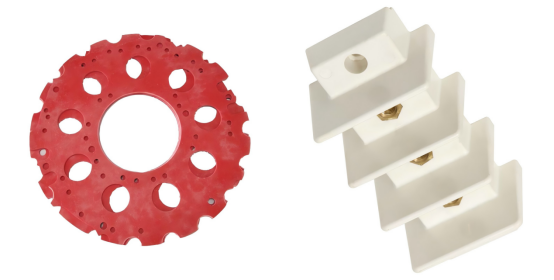
GPO3, limited to machining flat or simply cut parts (unable to form complex curved structures), is widely used for core electrical insulation components such as phase insulation baffles, arc-extinguishing sheets and busbar support plates in high-voltage switchgear; interlayer insulation and lead supports in transformers and reactors; armature and slot insulation in motors and generators; and high-voltage box insulation baffles in new energy charging piles and energy storage systems. It is also the preferred material for arc-resistant electrical safety parts like fuse brackets and traction converter insulation boards for rail transit.
SMC, with its advantage of compression molding into complex 3D structural parts, is a staple for load-bearing shells and structural components including outdoor electric meter box and distribution box enclosures (its most classic application), ring main unit and prefabricated substation housings; new energy vehicle battery pack covers, bumper skeletons and chassis guards; outdoor charging pile enclosures ; communication base station radomes and photovoltaic combiner box shells in the communication and photovoltaic industries; and complex high-voltage electrical structural parts such as post insulator sheds and insulation flanges. It is also extensively used for rail transit equipment compartment cover plates and seat frames due to its excellent weather resistance and corrosion resistance.
In summary, GPO3 is a high-performance electrical insulation laminate that prioritizes electrical safety, suitable for internal insulation flat parts in electrical equipment; SMC is a high-strength molded composite that focuses on structural load-bearing and molding performance, ideal for complex-shaped shells and structural components in outdoor and harsh environments.
RDS composite is a professional manufacturer specialized in the production of GPO3 sheets, SMC sheets, machined and molding components, with mature production technology, advanced manufacturing equipment and a strict quality control system. With reliable product performance and perfect after-sales service, we are committed to providing customers with one-stop material solutions and becoming your trusted long-term cooperation partner.