EN
EN



What is a CNC Machining Center?
A CNC machining center, or Computerized Numerical Control machining center, is a highly automated and multi-functional machine tool integrated with a tool magazine and an automatic tool changer.
By virtue of numerical control technology, CNC machining centers boast prominent advantages including stable machining quality, high machining precision, excellent repeatability, the capability to machine complex surfaces, and high machining efficiency.
1. Classification of Machining Centers
CNC machining centers are mainly categorized into four types: vertical machining centers, horizontal machining centers, gantry machining centers, and universal machining centers.
Vertical Machining Center
Adopting a fixed column structure with a rectangular worktable, it is suitable for machining disc, sleeve and plate parts. Generally, it is configured with three linear motion coordinate axes (X, Y and Z axes), and a fourth A-axis can be additionally installed on the worktable as required.
Horizontal Machining Center
It is typically equipped with a movable column, with the spindle box positioned between the two columns and able to move vertically along the guide rails. This type of machine tool has three basic linear motion axes: the X-axis for horizontal movement, the Z-axis for longitudinal movement and the Y-axis for vertical movement. A fourth optional A-axis can be mounted on the worktable, making it capable of machining spiral profiles, cylindrical cams and other similar components.
Gantry Machining Center
Its spindle is mostly installed in a vertical manner, and it is equipped with an automatic tool change (ATC) system and interchangeable spindle head attachments. The supporting system software has comprehensive functions that enable multi-purpose operation, making it an ideal choice for processing large-sized components.
Universal Machining Center
Also referred to as a five-axis machining center, it integrates the processing capabilities of both vertical and horizontal machining centers. After a single workpiece clamping and setup, it can complete the processing of all sides and the top surface of the workpiece except for the mounting surface.
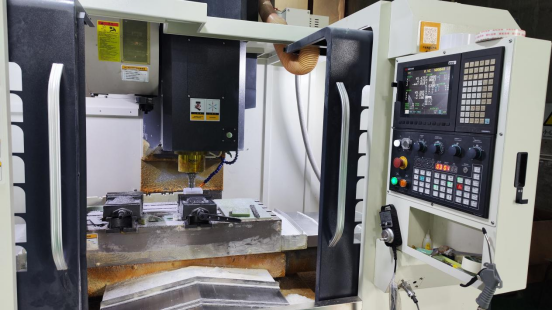
2. Main Components of a Machining Center
A CNC machining center is composed of several core components, each undertaking specific functions to ensure the smooth operation of the whole equipment, as detailed below:
(1) Basic Frame Components
As the fundamental structural part of the machining center, it consists of the bed, column and worktable. These components mainly bear the static load of the machining center itself and the cutting load generated during the machining process, so they require high structural rigidity. Usually made of cast iron or welded steel structures, these large-sized parts are the heaviest and most voluminous components of the machining center.
(2) Spindle Components
The spindle assembly is made up of the spindle box, spindle motor, spindle and spindle bearings, among other key parts, and it is the core component responsible for driving the cutting tool to rotate and realize the cutting operation.
(3) CNC System
The numerical control system is the "brain" of the machining center, composed of a CNC device, a programmable logic controller (PLC), a servo drive device and an operation panel. It is responsible for receiving, processing and sending machining instructions to control the coordinated movement of each axis and the execution of various machining actions.
(4) Automatic Tool Change System
This system is composed of a tool magazine, a manipulator and a drive mechanism. When a tool change is needed during the machining process, the CNC system will issue a corresponding command, and the manipulator (or other designated mechanisms) will automatically take the required tool out of the tool magazine and insert it into the spindle hole to complete the tool change operation quickly and accurately.
RDS Composite is equipped with a full set of advanced production and processing equipment, including custom-designed modern resin mixing and treatment systems, prepreg treatment lines, laminate pressing machines, molding press machines, winding machines, as well as CNC machining centers, mills and routers. Relying on this sophisticated equipment, we are able to produce a variety of composite materials with high and stable quality, which can meet the diverse requirements of different international standards.